

This post was originally published on this site.
It’s swimsuit season once again, and many men will find themselves lounging at backyard pool parties and hitting the beach.
Hanging out in just a swimsuit can make some guys feel self-conscious, for obvious reasons. You don’t have on any of the usual clothing and layers you can use to disguise or enhance certain aspects of your body, and you’re essentially standing in public wearing the minimum amount of fabric society permits.
Even if being out and about in a swimsuit doesn’t make you actively self-conscious, you likely want to feel optimally confident when you don yours.
Whichever category you fall into, today we’ll give you some tips on how to look your best at the pool or beach. Fortunately, looking swell in a swimsuit doesn’t require having the physique of an Olympic swimmer or Marvel superhero; the impression you make can be significantly improved by choosing the right trunks for your particular qualities and wearing them with style and confidence.
Choosing the Right Suit for You
Match the Suit to Your Build
The swimsuit you’ll look best in partly depends on your body type.
If you’ve got an athletic build, just about every style will look good on you, and suits in solid colors that fit closely without clinging will be especially flattering.
But if you’re on the thin or heavy side, you’ll want to keep a few special considerations in mind:
If You’re Lean and Skinny
If you’ve got a slim physique, you want your swimsuit to add a little substance to it.
Avoid extremely slim or tiny swim briefs unless you’re intentionally channeling a European water polo player.
Instead, choose tailored trunks with some visual interest:
- Horizontal stripes
- Bold patterns
- Bright colors
- Side pockets
Patterns and details add visual weight and help create the impression of a more filled-out frame.
If You’re Carrying Extra Weight
Many men respond to a thicker midsection by sizing up dramatically. But this is the wrong way to go.
An oversized swimsuit doesn’t hide weight. It simply adds bulk.
Choose a suit that fits comfortably at the waist and falls cleanly from the hips.
Solid colors generally work better than busy patterns. Darker shades can create a slimming effect, though there’s no need to restrict yourself exclusively to black.
The key is structure. A suit that fits properly will almost always look better than one that’s several sizes too large.
Choose Colors That Complement Your Complexion
In addition to matching a swimsuit to your body type, you’ll also want to make sure it complements your skin color.
Fair Skin
If you’re pale and burn easily, avoid colors that wash you out. So skip light pastels that match your skin tone and colors like pale beige, light yellow, and white.
Instead, try:
- Navy
- Forest green
- Burgundy
- Medium blue
These colors provide enough contrast to create visual definition.
Medium or Olive Skin
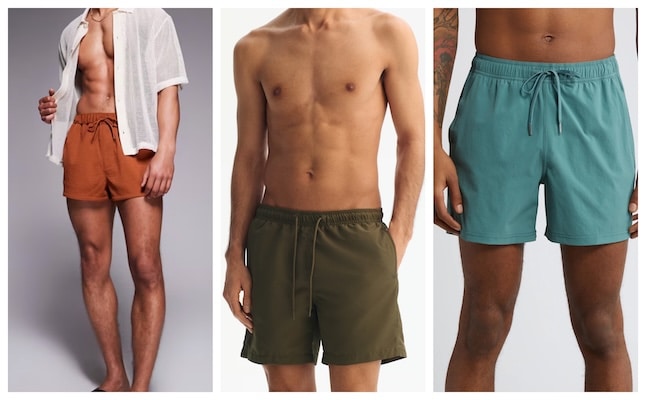
Medium and olive skin tones have the most flexibility when it comes to color. Few colors are off-limits, but medium and olive skin tones tend to look especially good in earthy colors and richer shades that complement the natural warmth of the complexion.
For example:
- Teal
- Olive green
- Coral
- Turquoise
- Burgundy
- Rust
This is the skin tone that can often pull off brighter colors without looking overwhelmed by them.
Dark Skin
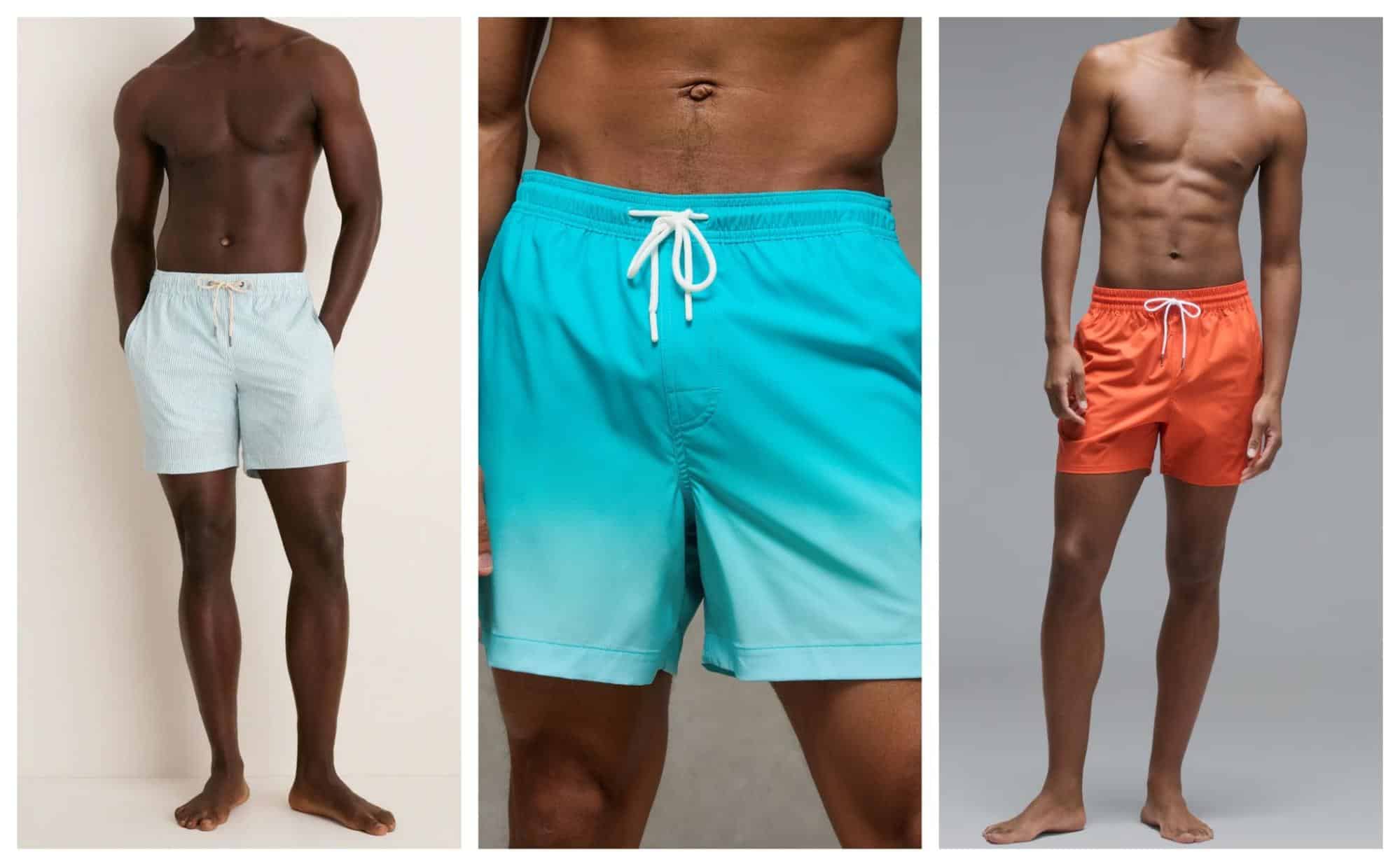
Rich, saturated colors tend to look especially good against darker complexions.
Consider:
- Emerald green
- Bright blue
- White
- Orange
- Yellow
- Red
Darker complexions should feel freer to experiment with bold colors.
Guidelines for All
Skip the Extra-Long Board Shorts
Many men gravitate toward long board shorts that reach the knee or even extend below it. That’s understandable. If you came of age in the ’90s or early 2000s, that’s simply the length that swim shorts — and everyday shorts — came in.
The hemline of shorts has inched up in the past decade for both casualwear and swimwear, and that’s something to embrace.
Long trunks aren’t inherently bad, but they can throw off your proportions. Because they cover so much of the leg, they tend to make your legs appear shorter and your body appear heavier than it actually is.
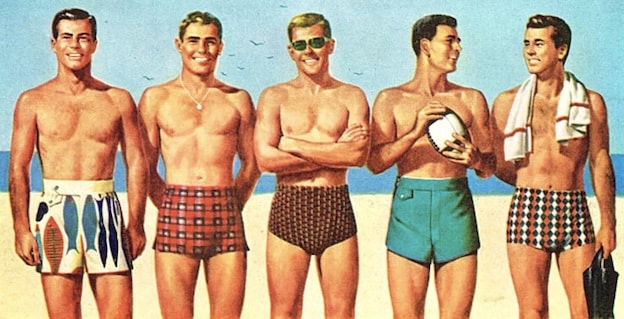
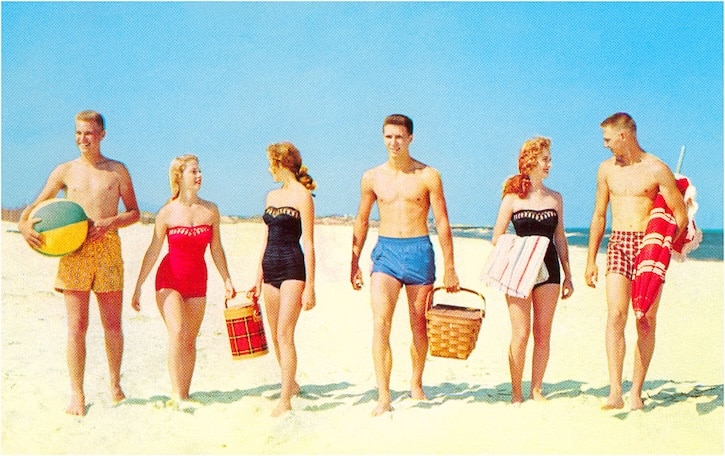
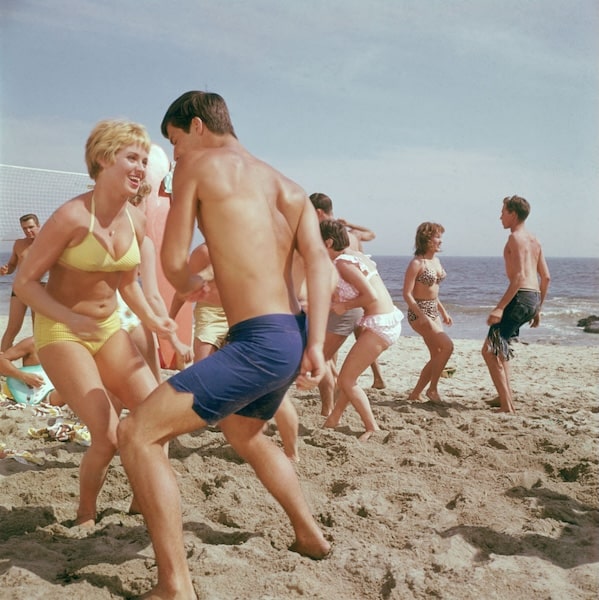
The longer shorts of the 90s/00s were actually an anomaly in the history of male swimsuits; for most of the time men have been wearing swimsuits, they’ve been shorter — sometimes quite a bit shorter!
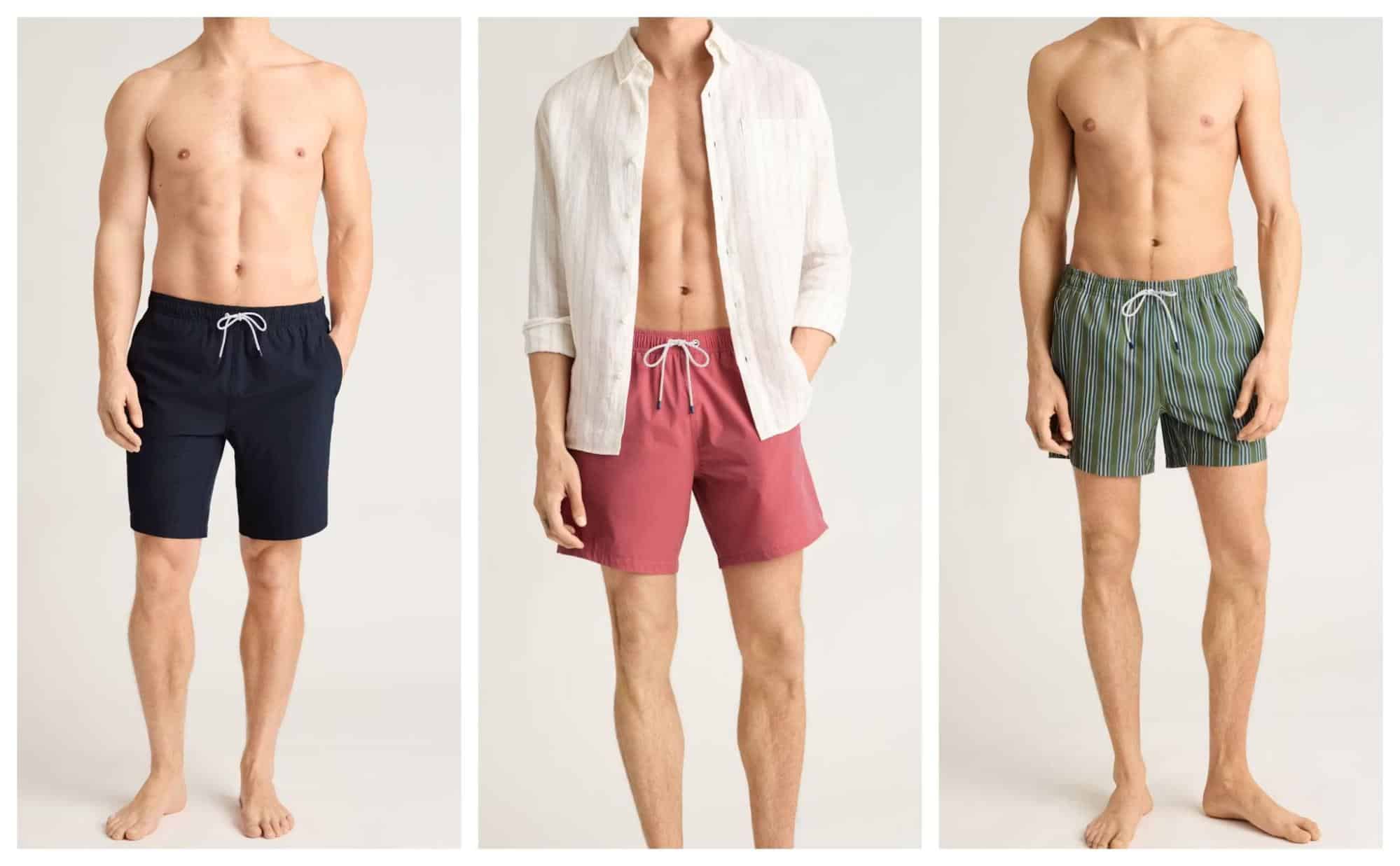
For most men, the sweet spot is a swimsuit with an inseam between 5 and 7 inches. This means the hem lands somewhere in the middle of the thigh, several inches above the knee. This length creates a more balanced and flattering silhouette.
If you’re under 5’10”, lean toward the shorter end of the range. Showing more leg creates the illusion of height.
If you’re tall, you can comfortably wear 7-inch trunks without looking disproportionate.
But unless you need long board shorts for a functional purpose, most men shouldn’t be wearing suits that fall below the top of the knee.
Skip the Novelty Prints
Swimsuits sometimes come in “fun” novelty prints — cartoon sharks, pineapples wearing sunglasses. But these read as jokey frat guy on spring break rather than a sharp, mature man — a poolside smooth operator.
Stick to solid colors and classic patterns and prints.
Mind the Waistband
Most men will look best in a traditional swim trunk with an elastic waistband and drawstring. It’s comfortable, forgiving, and works on a wide variety of body types.
The lace-up board-short waistband popularized by surf brands has its place, particularly for surfing and other watersports. But for everyday swimming and beachgoing, a classic elastic waistband is usually the simpler and more flattering choice.
You’ll want to keep the waistband sitting comfortably at your natural waist or slightly below it, rather than halfway down your hips; wearing trunks too low is one of the easiest ways to look sloppy in swimwear. When trunks ride too low, they shorten the legs and emphasize the stomach.
A properly positioned waistband creates cleaner proportions and makes nearly every body type look better.
The drawstring should be functional, not decorative. If the suit can’t stay up without being tied like a sailor’s knot, it’s probably the wrong size.
Don’t Forget What’s Above (and Below) the Waist
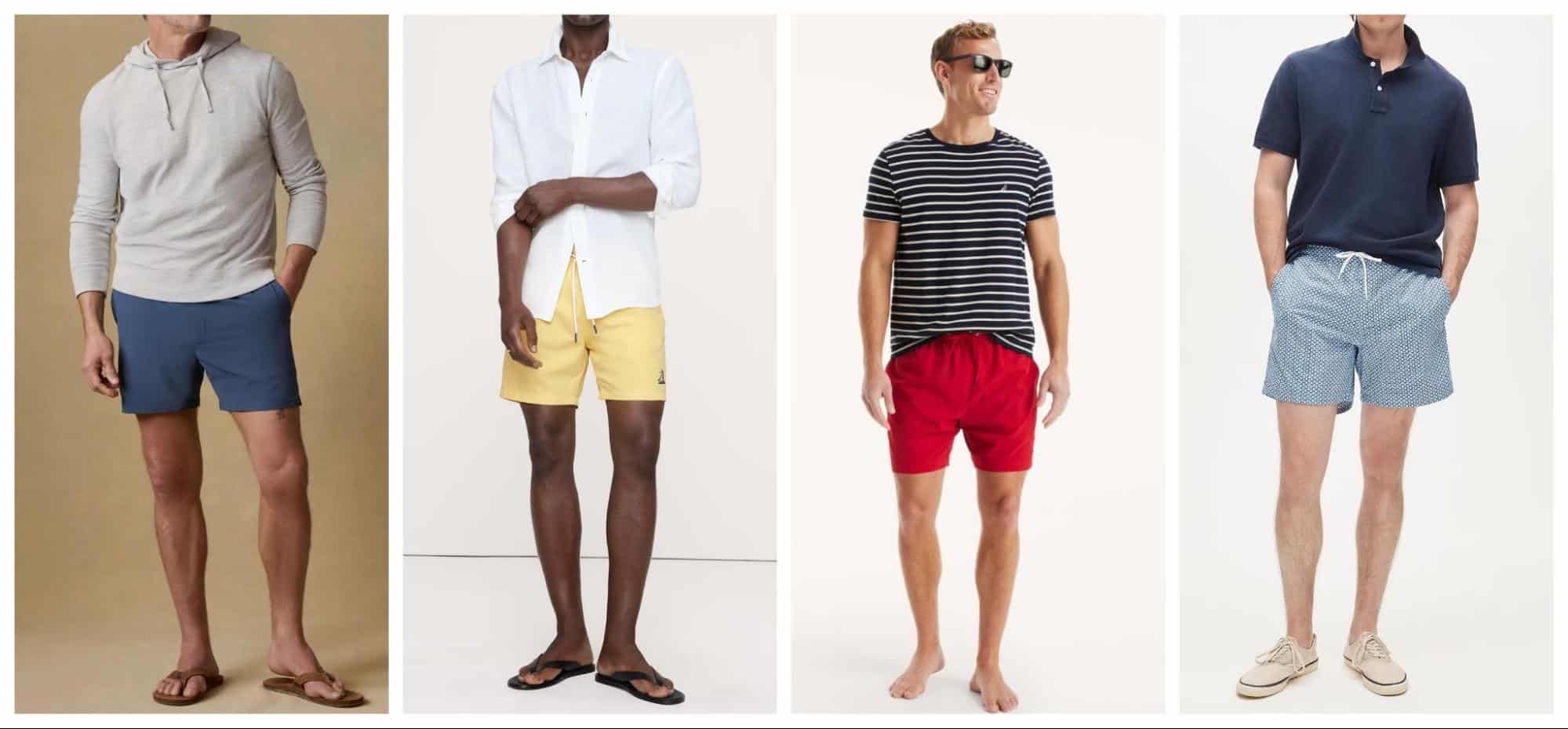
A swimsuit isn’t the entirety of your beach attire.
The man who looks best poolside is often not the man with the best physique but the man who understands the value of accessories.
Consider adding:
- A well-fitting linen shirt
- A polo made from lightweight fabric
- Classic sunglasses
- Leather sandals
These items provide structure and style while giving you something to wear when you’re lounging around the water and not actively in it.
They also help shift attention from your body to your overall presentation.
The Secret Advantage: Good Posture
If there’s one free upgrade available to every man, it’s posture.
Stand tall.
Pull your shoulders back slightly.
Keep your chest open.
Don’t cross your arms defensively over your stomach.
Most men at the beach unconsciously adopt a posture that communicates embarrassment. They hunch, slouch, and try to disappear.
Ironically, these habits make them look less appealing.
Confidence changes how clothing — and swimwear — hangs on the body.
A man with average genetics and good posture often looks better than a man with excellent genetics and poor posture.
When it comes to looking swell in a swimsuit, the right pair of trunks helps, but the secret sauce is simply exuding confidence and being comfortable in your own skin.
This article was originally published on The Art of Manliness.