

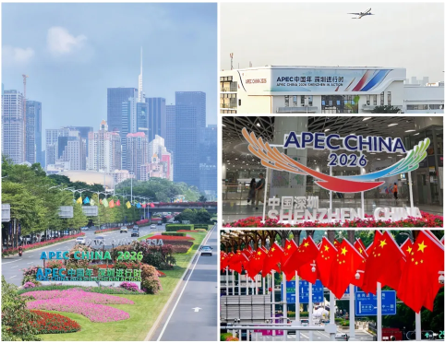
Along Shennan Avenue, APEC-themed banners unfurl in the wind; beside the main roads, bougainvillea, the city flower, adorns flower beds and themed green sculptures; inside Bao’an International Airport, multilingual signage and welcome displays greet visitors from all over the world. In November, Shenzhen is dressed up in celebration citywide.
On November 18–19, the 33rd APEC Economic Leaders’ Meeting will be held in Shenzhen — the first time in 12 years that China has again taken on the role of APEC host. Under the theme “Building an Asia-Pacific Community, Promoting Common Prosperity,” the meeting will focus on three priority areas: openness, innovation and cooperation. As a major business event under the APEC framework, the APEC CEO Summit is being held in Shenzhen on November 17–18, with discussions on topics such as the AI innovation ecosystem, Asia-Pacific digital economy cooperation, and the development opportunities of the Guangdong–Hong Kong–Macao Greater Bay Area and the Asia-Pacific. Artificial intelligence is rising from an industrial technology into a common language of Asia-Pacific prosperity.
As global attention converges on Shenzhen, how can Chinese AI companies demonstrate real, deployable industrial strength? Starting from a “tech calling card” at the airport, a closer look at SIXUNITED shows the practice of a company growing in step with Shenzhen’s electronic information and AI industries: building on terminal R&D and intelligent manufacturing, extending into computing power, software and engineering services, and expanding full-stack capabilities in the course of serving customers worldwide.
An International Window: From the Airport’s “Tech Calling Card” to the Industrial Front Line
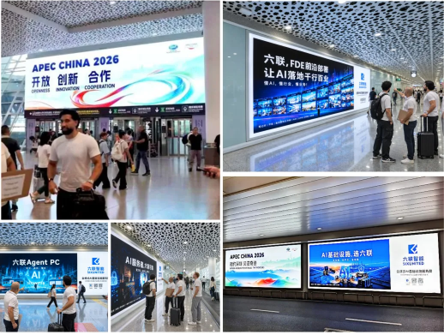
Shenzhen Bao’an International Airport is the first stop where many international visitors get to know the city. Among the airport’s corporate brand displays, keywords such as AI infrastructure, FDE (Forward Deployed Engineer), AI servers, Agent PCs and domestic Chinese IT innovation draw attention to SIXUNITED. From personal devices to enterprise computing power, and from product development to application deployment, this “tech calling card” presents directions for cooperation at different levels and serves as a window onto the depth of Shenzhen’s AI industry.
In Shenzhen, the appeal of “local tech specialties” is extending from smart hardware to the industrial capabilities behind the products. International buyers care about the functions and experience of devices, and also want to understand the R&D, supply chain support and service conditions behind them. A single product experience can be the starting point for going deeper into the industry and finding partners.
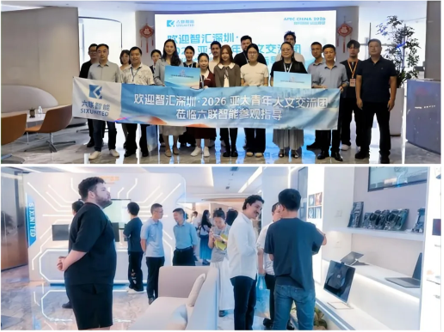
Ahead of the meetings, an APEC youth delegation taking part in the “Smart Shenzhen · International Youth Shenzhen Tour” program visited SIXUNITED for exchanges on cross-border market adaptation, AI security and overseas business models. As a SIXUNITED representative introduced, product development requires understanding local standards, usage environments and user needs in the early stage of a project, before carrying out product definition and configuration adaptation. Moving from viewing devices to understanding the development process, the exchanges went deep into the engineering conditions required for technology to enter different markets, letting international visitors see in concrete terms how Shenzhen tech companies take part in global cooperation.
Product Matrix: Turning Shenzhen’s Industrial Depth into Diversified AI Terminals
A company’s product expansion is closely linked to its city’s industrial direction. The Shenzhen Action Plan for Advancing AI and Application Development (2026–2028) proposes that by 2028, the scale of the city’s core AI industry will exceed RMB 300 billion, the number of AI companies will exceed 3,000, and the adoption of new-generation intelligent terminals, AI agents and other applications will be broadly promoted.
SIXUNITED’s product layout offers a concrete cross-section for observing this change. Laptops, tablets, Mini PCs and all-in-one PCs serve everyday computing needs; Agent PCs, AI workstations, AI NAS, AI servers and AI private cloud offerings further cover personal intelligent applications, professional computing and enterprise deployment, forming a layered portfolio that runs from terminals to computing power.
Mobile office work focuses on portability and connectivity, professional tasks stress performance and expandability, and enterprise applications call for coordinated data management and system integration. Cross-category development enables brands and integration partners to configure devices around actual tasks, balancing personal use, team collaboration and enterprise computing needs. Platform adaptation, in turn, expands the market options for products. SIXUNITED has laid out its products around Intel and AMD platforms as well as Loongson, Zhaoxin and Phytium, providing options for the performance, cost and adaptation requirements of different markets. Through the company’s R&D and engineering work, the supporting strengths of Shenzhen’s electronic information industry chain are gradually turned into product solutions for global customers — an industrial footnote to “an open, inclusive AI innovation ecosystem.”
Software–Hardware Integration + FDE: Delivering AI Capabilities to the Front Line of Business
Terminals and computing power provide the foundation, while software and engineering services determine how AI takes part in actual work. As Shenzhen deepens “AI Plus” applications, companies’ service capabilities also need to reach further into business scenarios.
SIXUNITED has extended its product system to personal assistants and enterprise platforms. The Mavly AI assistant supports users in initiating tasks through communication tools such as DingTalk, Feishu and WhatsApp, helping them look up information, organize materials and generate documents, and carrying out operations within the corresponding configuration and scope of authorization. The EAM enterprise agent management platform focuses on organizing personal and team knowledge, connecting to business systems such as ERP, PLM and MES to support on-the-job applications.
Going from software functions to business applications also requires adaptation and validation. Take enterprise information retrieval as an example: before deployment, it is necessary to confirm the sources and versions of materials, set access permissions and validate answer quality; where system calls and operation execution are involved, manual review checkpoints and exception-handling methods must also be defined. This work is advanced jointly by industry software partners and FDE engineering services: software partners provide specialized functions, while FDE engineers go deep into business front lines to sort out requirements, connect systems and carry out validation, linking hardware configuration, software functions and actual workflows together.
The key to “delivering application capabilities together with intelligent terminals” is moving the preparation work forward, reducing the burden on user organizations of assembling tools and building workflows on their own. Validated common workflows can also be consolidated into modules and then adapted to other customers’ data, systems and management rules. This “hardware + software + engineering delivery” service model also provides a corporate practice for Shenzhen’s effort to move AI from single-point applications to industry-wide adoption.
An R&D and Manufacturing Foundation: Seven R&D Centers and Seven Intelligent Manufacturing Bases Supporting Global Delivery
Business adaptation answers “how to use it,” while the R&D and manufacturing systems take on “how to deliver reliably.” For international customers, prototype validation, mass-production quality, supply continuity and follow-up maintenance together affect the pace of new product launches and project costs. At present, SIXUNITED has established seven R&D centers and seven intelligent manufacturing bases, with R&D directions covering terminal hardware, servers, the AI software ecosystem and domestically developed products, supporting cross-category development and volume supply.
Relying on the electronic information industry chain in and around Shenzhen, the company can organize component selection, structural design, software adaptation and engineering validation to advance in coordination, and then take on pilot and mass production through its intelligent manufacturing system. Local industrial support and cross-regional delivery capabilities connect with each other, giving product innovation the foundation to enter global markets.
Transforming from an ODM/OEM manufacturer into a full-stack AI infrastructure service provider, SIXUNITED has extended its R&D and manufacturing expertise into software platforms, industry applications and engineering delivery. The content of cooperation with global partners has also expanded from whole-machine development and supply to joint software–hardware development, business adaptation and continuous service. This trajectory echoes the direction of industrial chain collaboration in the Asia-Pacific region, and also reflects the change in Shenzhen’s tech industry: deepening software–hardware synergy on top of hardware strengths, and raising the value of the industry chain through application services.
Seeing the Future Here: Turning Innovation into Value You Can Use
APEC opens a new window for industrial exchange in the Asia-Pacific and brings wider attention to the practices of Shenzhen’s tech companies. What international visitors see is not only innovative products, but also the industrial system that supports product development, application deployment and sustained supply. As industry experience is embedded into software and application capabilities are delivered along with terminals, global brands and industry partners have the opportunity to jointly develop products closer to user needs, bringing AI into more jobs and business front lines. For SIXUNITED, rooted in Shenzhen, making the most of the APEC opportunity to keep turning technological capabilities into deployable, scalable solutions and cultivating collaborative innovation in the Asia-Pacific is a pragmatic path for seizing the opportunities of the times. Starting from Shenzhen and working with Asia-Pacific partners to turn visible innovation into usable value — this is both an industrial footnote for Chinese AI companies on the APEC stage and a concrete corporate practice of “building an Asia-Pacific community and promoting common prosperity.”